
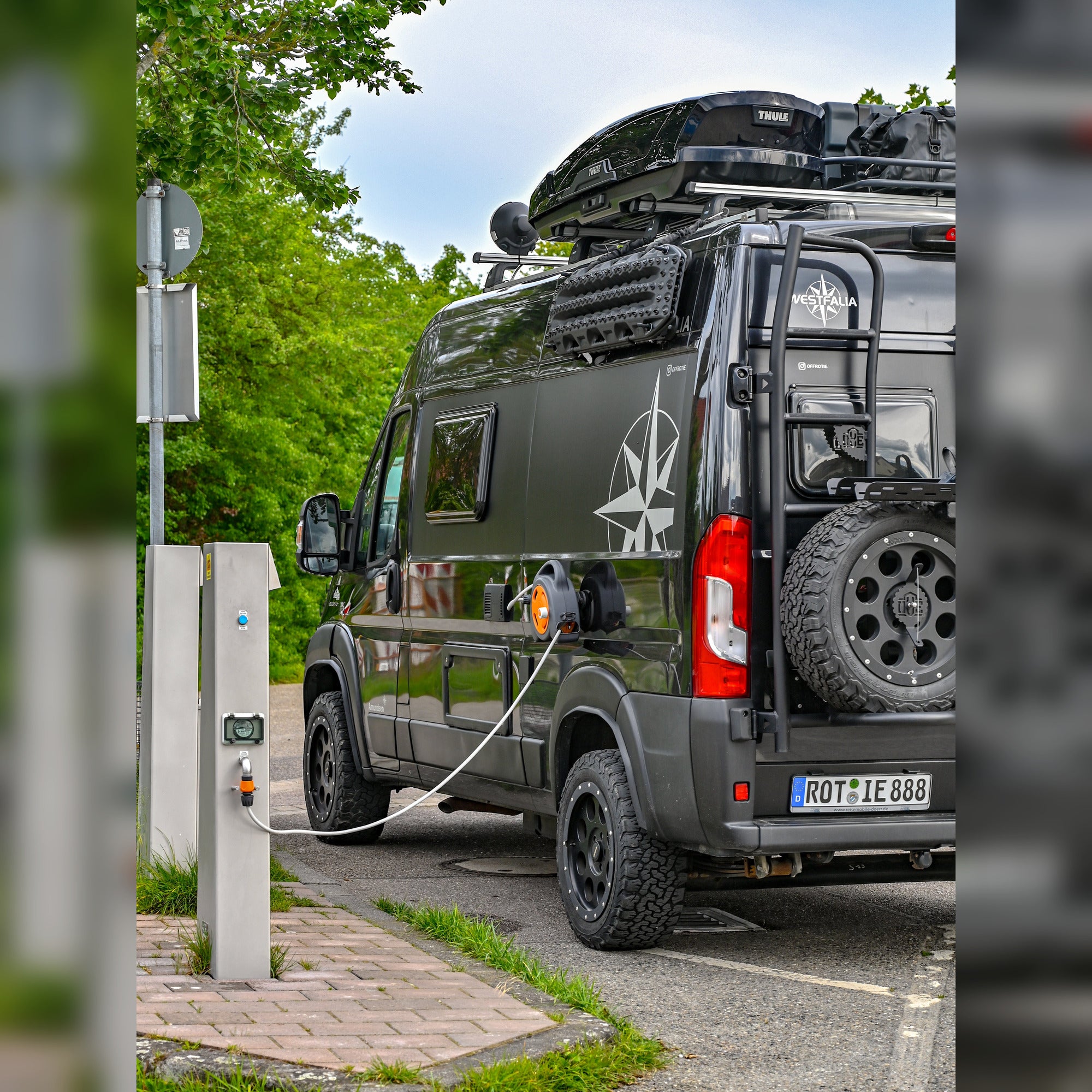
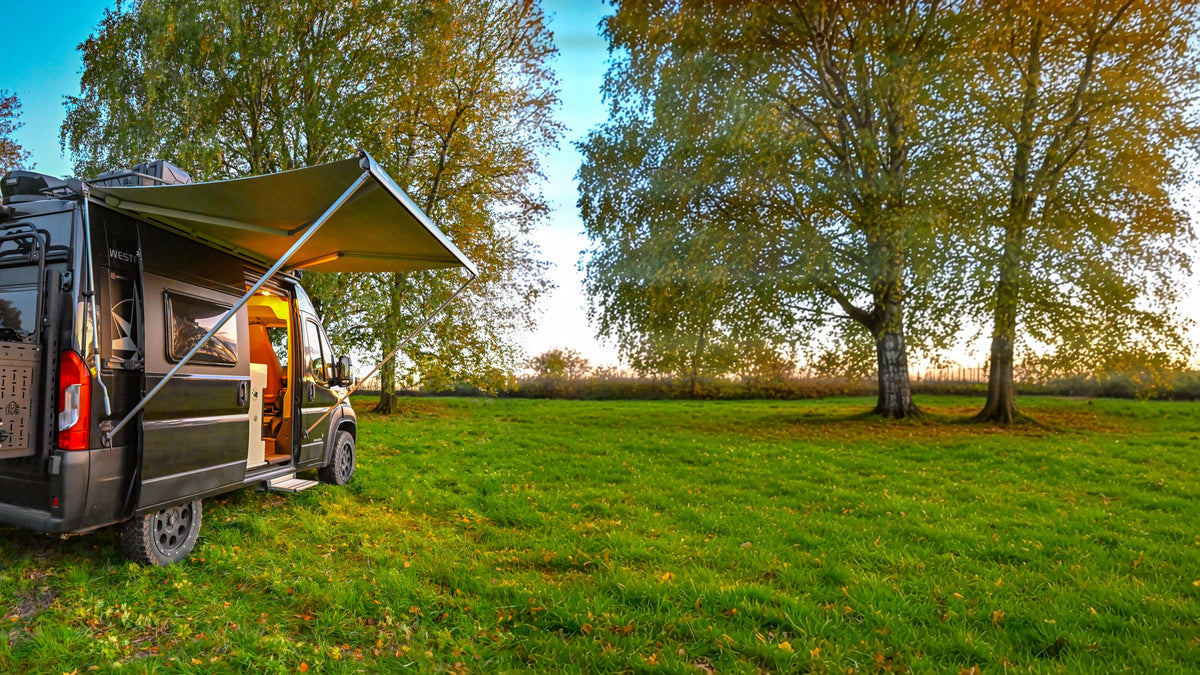
If you live in a van long enough, you already know this: the wind does not care how carefully you parked, or which awning you bought. It hits the fabric, and the legs have to deal with it. That is true whether those legs are pegged into the ground, stuck to a suction cup, or held with magnets.
For a long time we did what most people do. We got out the pegs, walked around looking for a patch of ground that would take them, and spent a few minutes hammering, adjusting, and hoping the soil would hold. On a soft campsite that can work. On hard, rocky or paved ground, it often does not. And when a real gust arrives, pegs can pull out. Once the legs are free, the awning takes the wind on its own, and that is how fabric and arms get damaged.
We got tired of that ritual. So we designed a different way to hold the legs, and we have used it on Rotie ever since.
Why pegs struggle when the wind picks up
An awning is a sail. The legs only do their job if they stay where you put them. Pegs rely on the ground: soil, grass, gravel, a lucky crack in a car park. That search takes time and effort, especially at the end of a long drive. On rock, packed dirt, concrete or tarmac, there is often nothing honest to drive a peg into. Even when they go in, a strong gust can yank them out.
Suction cups have the same kind of problem in a different form. They look convenient until the surface is dusty, cold or slightly uneven, and then they let go.
Wind hits any awning, however you secure the legs. The real question is whether the legs stay put when it does.
How we hold Rotie’s awning now

On Rotie we screw a magnetic holder into the M8 foot hole at the bottom of each awning leg, then place the magnet on the metal side of the van. No tools, no holes in the ground, and no drilling into the bodywork.
Each holder uses a rubberized neodymium magnet (NdFeB, with a nickel coat and a rubber coat) with 55 kg of pulling force. There are two of them, one per leg. The rubber coating is 2 mm thick, which protects the paint, and the magnets are UV-resistant, so they can also be used on foiled surfaces. They need a metal surface at least 2 mm thick, the kind of skin you find on a van or a bus.
The handle is die-cast zinc, the screw is stainless steel, and the pair weighs 580 g. A built-in clamping lever lets us tighten or loosen the leg on the magnet body without a second tool. When the magnets are not on the van, they sit in a plastic protection base and travel in a small pouch. They are made in Germany, and they fit any awning brand with an M8 sized foot hole.
The point of all that is simple: we can put the awning up on gravel, concrete, tarmac or rocky ground, and leave the magnets on the van for the rest of the stay. They do not wander off looking for a better patch of soil.
You can find The Awning Legs Magnetic Holder in our shop, with the full specifications and the user guide.
When the wind makes the case for magnets

A windy pitch is usually the moment people start to worry. For us, it became the moment that showed how well the magnets hold. Because they are on the van, not in the ground, a gust has no peg to pull out of dry earth. The holders stay. That is the proof we wanted.
We are not the only ones who have noticed. Michael, who bought a pair, left this review on our product page in August 2025:
“Es war genau die richtige Entscheidung genau diese Halter zu nehmen. Sie Haben bereits Windstärke 5 überstanden und lassen sich dank der Hebelwirkung des Griffes super leicht vom Blech abzuheben.”
Our translation: “Choosing exactly these holders was exactly the right decision. They have already come through wind force 5, and thanks to the leverage of the handle they are super easy to lift off the metal.”
— Michael, verified buyer, review on offrotie.com
That is his experience on his own van, and we love hearing it. It is not a rating we put on the product.
There is also an important limit, and we are careful about it. The magnetic holders can withstand very strong winds, but the awning itself cannot. We never go past the wind limit set by the awning’s manufacturer. If the weather turns properly stormy, we roll the awning in. The magnets are there to keep the legs still, not to turn a canvas roof into an all-weather shelter.
We also never lean on the legs or put extra downward force on them. That can make the magnets slip. They hold by magnetism, not by being stood on.
How we set up the magnetic awning holders on Rotie. No tools, no pegs.
A few habits that protect the van, and the awning
These are the habits we follow on Rotie, and the ones we ask anyone using the holders to follow too.
We always clean the paint before the magnets go on. Dirt, grit or sand trapped between a magnet and the bodywork is what scratches a van, not the rubber itself. A quick wipe with a microfiber cloth is enough, and it also helps the magnet get a proper hold.

We bring each magnet in at a 45-degree angle, using the handle, and we keep our fingers out from between the magnet and the metal. These magnets are strong. They will close the gap if you let them, and they are not gentle with skin.


When it is time to pack up, we close the awning the way its manufacturer describes, then use the handle as a lever to lift the magnet off. The magnets always come inside the van before we drive. They are not for use on the road.

For storage, each magnet goes back into its plastic base and into the pouch. That stops them grabbing other metal in a drawer, and it protects the rubber. We never let the two magnetic faces snap together. If they do, they are very hard to separate. The way out is two people, one on each handle.
One more note on temperature: the magnets lose adhesion above 80°C, so we check the surface if Rotie has been sitting in fierce sun.
What if your van is not steel?
The holders need metal. They are made for a steel van or bus skin, at least 2 mm thick. On plastic or fibreglass RVs they will not get that hold, and we would not pretend otherwise.
We hear that question often. The good news is that we are working on an exciting new technology that will work on virtually any surface, coming soon. Until then, the magnetic holders are for metal bodywork.
FAQ
Do the magnets scratch the paint?
The magnets are rubberized to protect the surface, and they are suitable for foiled vans too. The real risk is dirt left on the paint. Clean the spot with a microfiber cloth first, then attach the magnet.
Will they hold in the wind?
The holders can withstand very strong winds, and because they do not rely on the ground, they cannot be pulled out the way pegs can. One customer, Michael, wrote in his review that his have already come through wind force 5. The awning itself still has a wind limit, so stay within its manufacturer’s rating and roll it in if it gets stormy.
Do they fit my awning?
If your awning legs have an M8 foot hole, yes. They work with any awning brand that has an M8 sized foot hole.
Can I leave them on while I drive?
No. Always take the magnets inside the van before you move off.
Can I use them on a plastic or fibreglass RV?
Not these holders. They need a metal surface at least 2 mm thick. We are working on an exciting new technology that will work on virtually any surface, coming soon.
Over to you
How do you secure your awning when the ground is hopeless, or when the wind gets up? Pegs, magnets, or something else? We would love to hear what has actually worked for you on the road.



Leave a comment
All comments are moderated before being published.
This site is protected by hCaptcha and the hCaptcha Privacy Policy and Terms of Service apply.