
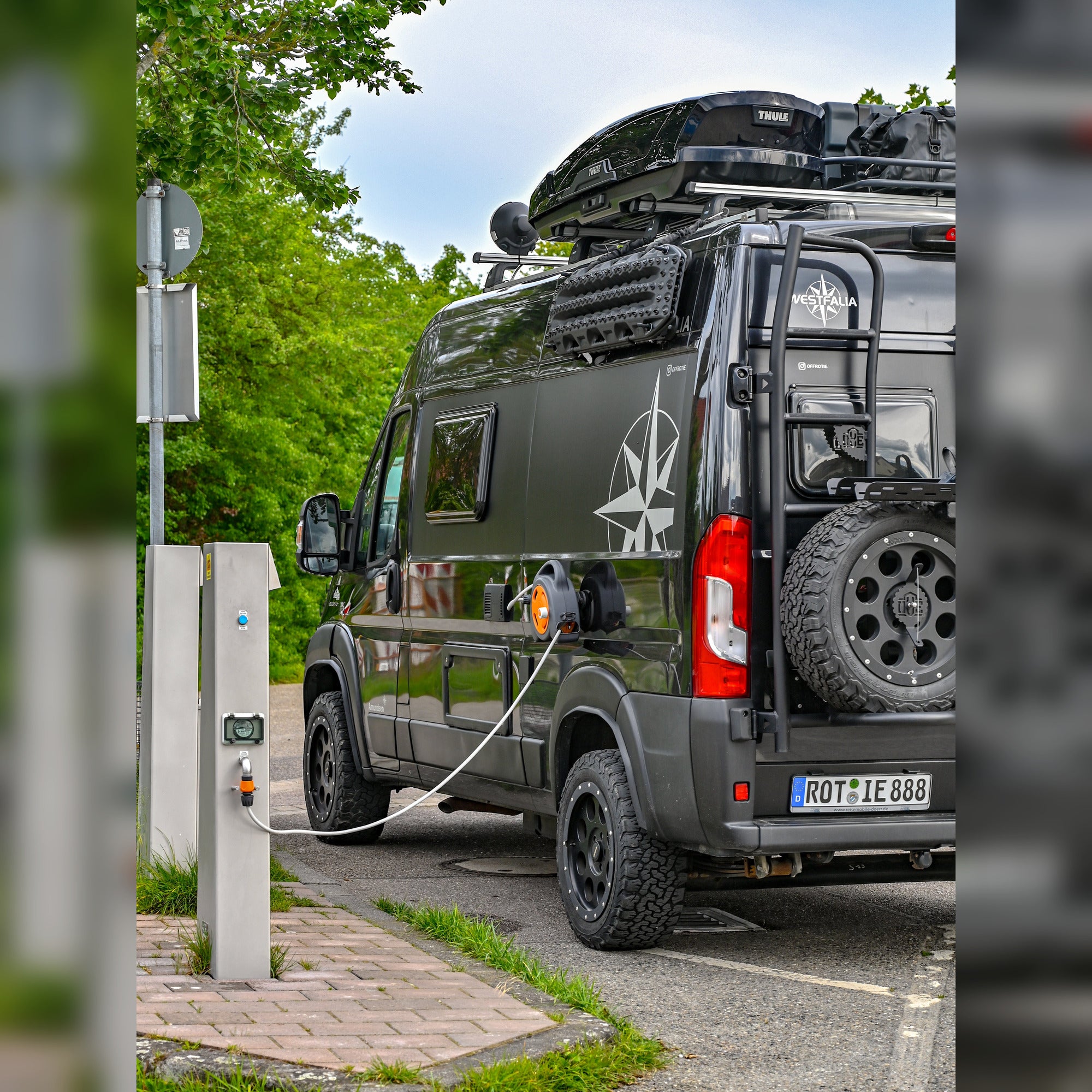
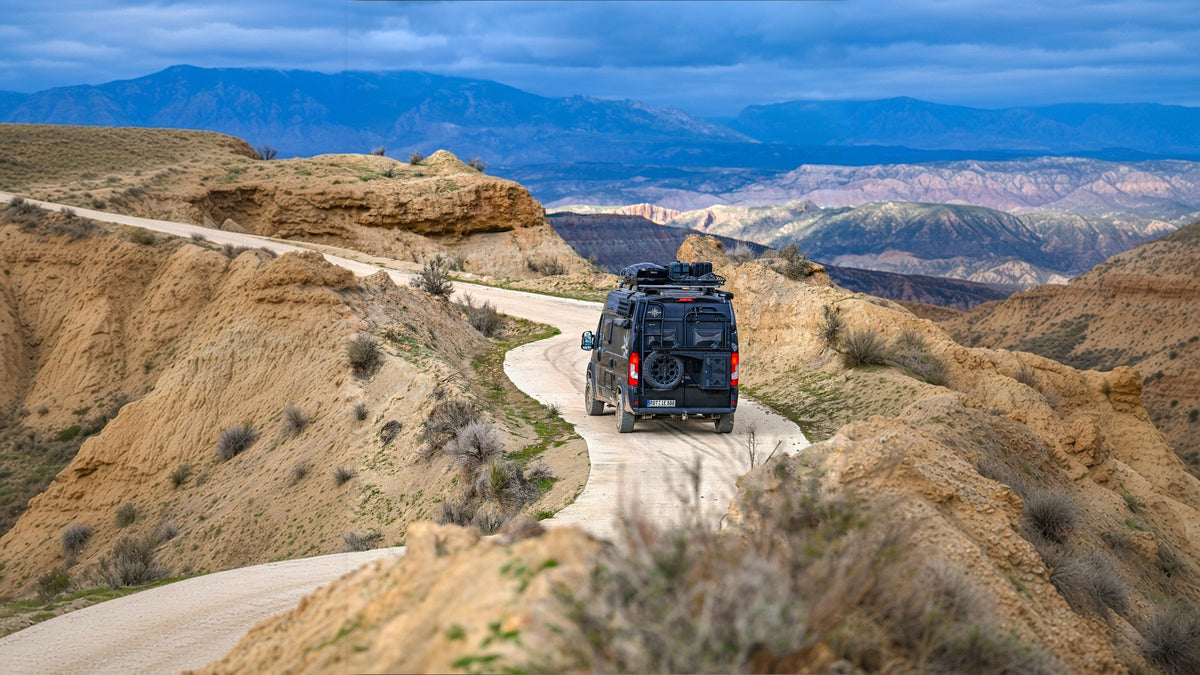
People have called us overlanders just because Rotie looks the part: big tires, a roof rack, a row of lights. We used to smile at that, until we thought about the places we were going.
Rotie is our black 2019 Fiat Ducato. She arrived in the summer of 2019, after exactly a year of waiting, already a 4x4, with a Westfalia-built interior.
In November 2023 we filmed a walkaround of her equipment and capabilities. The short version is on Instagram; the longer tour is on YouTube: Van Equipment Tour | The Ultimate Fiat Ducato 4x4 OFFROAD RIG. What follows is that tour, written down, with the story around it.

A name, and a beginning
“Rotie” comes from ROT, the letters on our Rothenburg licence plate, plus “IE”. The “Off” fell into place later, on the drive home from the Abenteuer & Allrad fair, when off-road finally clicked as part of the name. That is how Offrotie was born.
Our first trip outside Germany came in the summer of 2020, after months of lockdown, with two old chairs and a lot of enthusiasm. The longest trip so far was six weeks and seven countries: the Austrian Alps, Liechtenstein, Italy, a ferry to Sardinia for our first kitesurfing sessions, then Albania, Montenegro, Croatia and Slovenia. In Albania we discovered a real love for off-roading, even with a healthy fear of rocks.
Rotie had been a 4x4 from day one, ordered for her off-road capability, but we had not really used it until specialised training showed us what she could do. Our Fiat Ducato held its own next to the big names.
The base: a 2019 Fiat Ducato, Westfalia on the inside, Dangel underneath
Under the badges, Rotie is a Fiat Ducato with a 2.3-litre engine, 130 HP. We also did chip tuning, and gained around 36 more horsepower. That tuning is from TEC Power Tuning, as we noted on the Instagram version of the same tour. The body is a Westfalia Amundsen, the interior we live in every day.
The 4x4 system is by Dangel, a French company that only converts new vans. As far as we know, they no longer convert the Fiat Ducato, but still do conversions on new Peugeot and Citroën vans. It distributes torque through two transfer cases, one in the front and one in the back. Between them, a hydraulic coupling automatically sends torque from the front axle to the rear axle. We also have a differential lock on the rear axle, which we can engage with a button from inside the cab. That rear locker helps when the surface turns loose or uneven.
Wheels, suspension and lights
Rotie wears Delta 4x4 rims and BF Goodrich all-terrain tires, size 255/55 R18. We also upgraded the suspension, and there is a lot of ground clearance: Goldschmitt shock absorbers in the front, and Goldschmitt airbags in the back. Goldschmitt is a German company.
For dark tracks and unlit pitches, a row of Hella Luminator Metal off-road lights sits on the roof. We like the round look, and when they are on we get a 180-degree angle of view. The ones at the front help with potholes and rocks, and we also have fog lights.
Those all-terrain tires are also why we care about air. In the rear box we carry our 4-tire inflation and deflation system, so all four tires can be adjusted at once, and a portable 12V compressor in a hard case. The compressor is our 300 LPM dual-cylinder model. Both are accessories we take on the road, not equipment built into Rotie, and we use them together whenever the tires need air.
What we carry on the back and on the roof

At the rear, Rotie has a box, a bike carrier for two bikes, and a spare tire carrier, all from Overland Van Equipment, another German company. The box holds the bulky, dirty kit: recovery gear, a saw, the tools, and that four-tire inflation system. The bike carrier sits a little high, so we keep a stool handy, and we added Thule bike holders with keys, because the original Overland holders did not come with them. The spare tire carrier is attached to the door, with another Delta rim, ready if we need it. A ladder on the back takes us up to the roof, which we use often.
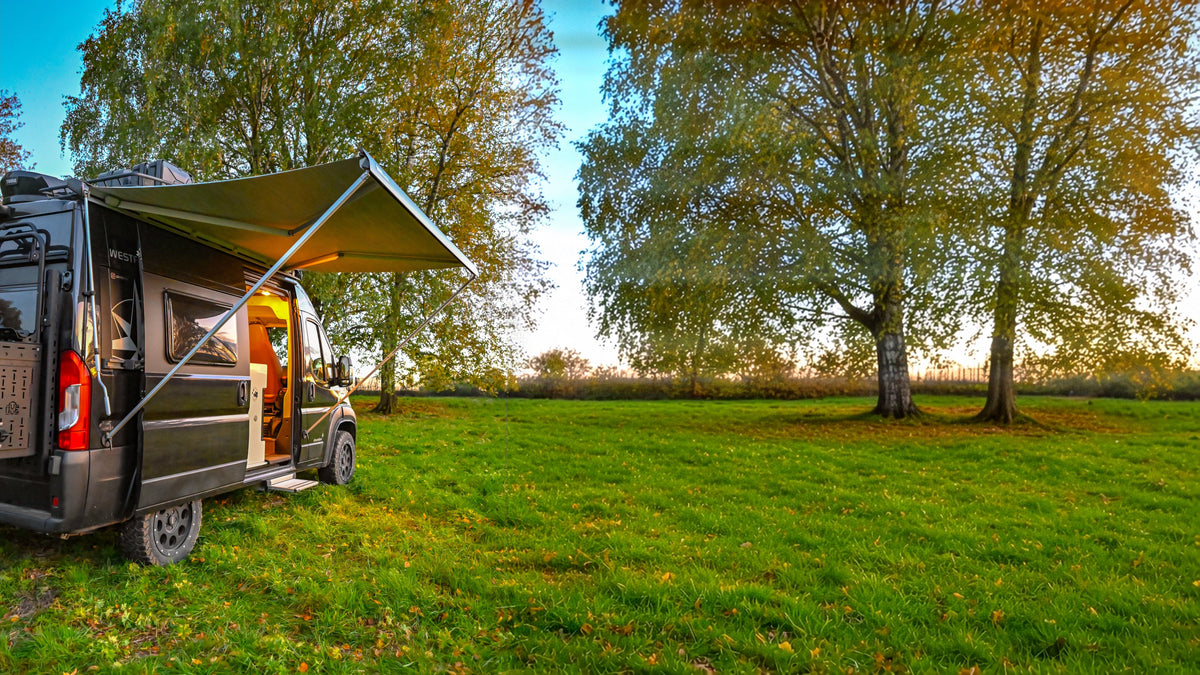
On the roof we run a Thule travel box and a Thule basket with Front Runner accessories. The travel box is for our kitesurfing gear; we have three kites on board. On the basket we have two boxes, two jerry cans for fuel, one water tank, and a bag for our Starlink, our communication channel. We also have a 100-watt solar panel up there, and a Thule Omnistor awning.
We carry two Maxtrax Xtreme recovery boards on the roof as well.
Among the other accessories we carry on the road are our Starlink Mini magnetic holder and The Kitchen Cube, our portable outdoor kitchen.
Water, power and the everyday interior

We carry 96 liters of fresh water, which we fill from a side compartment with a hose and a filter. For that we use our The Mini Hose Bag, a magnetic hose reel we take on the road, not equipment built into Rotie. A gray tank under the chassis collects the water from the shower, and there is a shower at the kitchen as well. The cassette toilet comes out with a telescopic handle, ready for the dump station.
In a side compartment we have a 2,000-watt inverter, which turns battery power into 240 volts, enough for almost everything, including the coffee maker. On the side of the van we also have an outdoor shower. There is a 240-volt hook-up as well, for campgrounds.

At the time of that tour we had two AGM batteries, 95 Ah each, for a total of 190 Ah, of which only half is usable. With Starlink and everything else running, a charge lasted two days at most. We were already planning a lithium upgrade, and thought we could fit around 300 Ah in the same space, which would almost triple the usable capacity. That upgrade has not happened yet, so this is still the system we were running then.
What we love, and what we would still change
We love that Rotie is both a home and a capable 4x4, and that awkward moments on the road have turned into tools we now build ourselves. What we would change is mostly weight. She is about 3.5 t fully loaded, and she does not get to say yes to every extra box. She is not finished, and a few things may have changed since that 2023 walkaround. The tour is a snapshot of Rotie as she was at that moment.
FAQ
What kind of van is Rotie?
A black 2019 Fiat Ducato with a Dangel 4x4 system and a Westfalia Amundsen interior.
What engine does she have?
A 2.3-litre Fiat engine with 130 HP, plus chip tuning from TEC Power Tuning of around +36 HP.
Can a Fiat Ducato really go off-road?
A standard one has limits. Rotie was ordered as a Dangel 4x4, with a rear diff lock we can engage from inside the cab, all-terrain tires, upgraded Goldschmitt suspension and proper recovery gear.
How much water and power do you carry?
In the 2023 tour: 96 liters of fresh water, a 2,000-watt inverter supplying 240 volts, a 100-watt solar panel, and two AGM batteries, 95 Ah each (190 Ah total), of which only half is usable. A lithium upgrade was already planned then, and has not been done yet.
Where can I see the walkaround?
The short Reel and the longer YouTube tour, Van Equipment Tour | The Ultimate Fiat Ducato 4x4 OFFROAD RIG., were both published in November 2023. Both are linked in this article.
Over to you
If you had to explain your own van in one short tour, which three pieces of equipment would you start with, and which one was the game-changer? Tell us in the comments.



Leave a comment
All comments are moderated before being published.
This site is protected by hCaptcha and the hCaptcha Privacy Policy and Terms of Service apply.